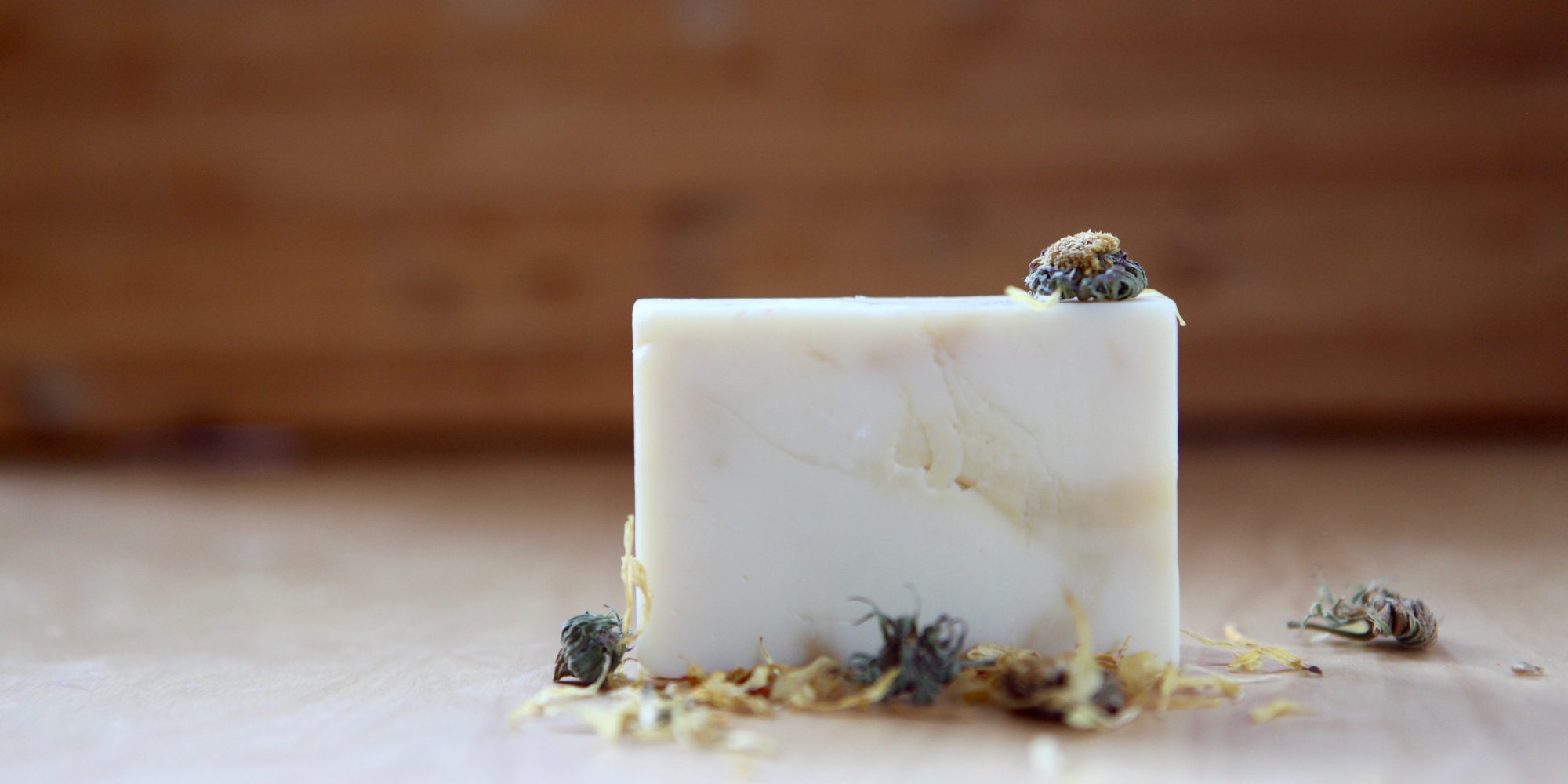
I totally encourage you to create your own combinations of soap based on what is the best for your skin and body! It’s not rocket science, but does take at least a basic understanding of oils and how they work, plus making sure your lye and water ratios are what they need to be. Thanks to some amazing online calculators (below is the link to the calculator I use), the math of finding those ratios is MUCH easier than it used to be! However, it is still important to understand what you are working with and how you might want to deviate a bit. I will share a few basics below to get you started and give you some good, basic guidelines to follow until you get more comfortable with formulating.
The soap formulating calculator I use: http://soapcalc.net/calc/SoapCalcWP.asp
- To use this, under 1) Lye– choose NAOH
- For 2) Weight of Oils, choose lbs and type in the number 2 (the default is set to 1).
- For 3) Water, choose “water as % of oils” and type in 32.
- For 4) Superfat, type in 5% for regular soap bars, and 15% for shampoo bars. Just below for Fragrance, type in .75
- Then in the drop down oil under section 5- double click on each oil you are using. For now you can ignore all the qualities and fatty acids numbers next to the oil choices- that will make more sense as you learn more about specific oils. Even then, formulating by those qualities can be problematic, and lack of certain qualities doesn’t mean it won’t be a good bar of soap. Ie: olive oil will show a very low “hardness” quality- yet when fully cured, an olive oil bar can be quite hard, unlike a low hardness quality for Hemp oil actually does mean a very very soft bar if it isn’t combined with harder oils.
- You will see your chosen oils in the Recipe Oil List to the right of the soap choices. I always put in the percentage of that oil I want in my total recipe instead of a lb amount- ie. for a bastille soap I would type in 95% next to my olive oil and 5% next to my other chosen oil.
- Lastly, next to 7- click on “Calculate Recipe”. A bar that says “View or Print Recipe” will appear underneath- click this and it will create a separate printable recipe page with the weights of lye, water , oils & essential oils you will need for your recipe. There is notes section you can type into with additives, etc to personalize your bars. I usually print out the recipe as a base recipe and write underneath the additives and names of the bar variations I make with each recipe.
There is so much you can learn over time! But I will cover a few formulation basics below to make things easier in the short term. If you don’t have the time or bandwidth for further research, these will still guide you towards making many types of soap or shampoo bars that will work well :).
Oil Amounts in a Recipe (Formulation)
So, a few basic “rules” to generally follow when formulating soap. I won’t go into detailed benefits of each oil here, this list is more for basic formulation.
One of my favorite ways to use Olive oil is to infuse is with different herbs several weeks ahead of my soap making with it. It takes a little extra planning, in terms of time, but adding the healing properties of herbs via infusion is a wonderful way to add extra qualities to a bulk ingredient in your soap.
- Olive Oil can be used at any percentage in a recipe. For my recipes, olive oil is the bulk of the recipes as it is gentle, nourishing, allergy friendly, and hardens to a nice bar, even when used at 100%- unlike most other oils.
- Rice Bran Oil can replace olive oil or blend with olive oil at any percentage as well. You can make a 100% rice bran oil bar. I personally have not, but you can. Rice bran is an oil commonly used in Japan.
Besides Olive and Rice Bran, most other oils need to be used in limited percentages, or they won’t work as well in a bar. Either creating a bar that is too hard, cracked or too mushy. They are meant to work in combination with a main oil, like olive or rice bran. Below are oils that I often use in my recipes. Besides being coconut and palm free, I don’t use any tree nut oils or avocado oil because of the allergies in my family, so depending on your allergy profile there are likely several other oils to look up and explore that I haven’t listed below.
- Castor oil- recommend to use at 5-10% in regular bars, or up to 15% in a shampoo bar recipe.
- Meadowfoam Oil- recommend to use at 5-10%. I like this oil as it is similar in viscosity and properties as jojoba, but doesn’t have the same allergy profile that jojoba can have. This is my favorite oil to add to shampoo bar recipes.
- Camellia Oil (Green Tea Seed)- recommend to use at 2-10%
- Hemp Oil- recommend to use up to 15% in a recipe. I have made bars with Hemp up to 50%/50% with olive oil, but they are definitely softer bars when using. I do like hemp though for it’s healing qualities and don’t mind the softer quality when I need that bar.
- Cocoa Butter- recommend to use at 5-15% in a recipe. More than that and you get a soap bar that cracks very easily.
- Jojoba Oil- recommend to use at 5-10% in a recipe.
- Beeswax- recommend to use up to 5% (more in a recipe can create a waxy “drag” to the bar) in a recipe.
Below are a few additional oils that I don’t use in soap myself, but are nice for formulating as well- again, depending on your personal allergy profile.
- Abyssinian Oil- recommend to use up to 5-10% in a recipe
- Rosehip Seed Oil- recommend to use at 5-10% in a recipe
- Sunflower Oil- recommend to use up to 15% (like hemp, more can create a very soft bar) in a recipe.
- Avocado oil- recommend to use up to 15-20% in a recipe.
Water Amount (and discounts)
The soap calculator link near the beginning of this post will automatically set to water amount as 38% of the recipe. That is a lot of water to use, but it is usually recommended that beginners use more water when learning soap making vs less. The percentage amount I recommend is a very steep water discount for new soap makers… but, I have found that with high olive oil soaps, using the amount of water usually recommended for new soap makers creates a bar of soap that takes forever and ever to get out of your mold (think 2 weeks or more) and they takes more along the lines of 6-12 months to cure. Curing is basically the time it takes for the water to evaporate out of the bar, leaving a nice hard soap bar. By using less water, this process still takes awhile, but less time overall- and, especially with the olive oil bars, you can take out of your mold to cut and start the curing process in around 24hrs. I will often use an even steeper water discount, but it is something I am very used to at this point- but is something you can play with over time, depending on the batch you are making. The plus side to using more water in a recipe, is your trace will be thinner for a longer amount of time- this is great for those who want to learn how to make various designs in their bars… likewise the downside of using a very steep discount is your soap batter thickens faster, making it a little more tricky (and potentially less pretty, depending on what you are adding to the soap) to get into the mold. Also (see note on additives) there are certain essential oils that can cause your batter to “seize”, meaning thicken up extremely fast making it more like scooping mashed potatoes into your mold, which is fine for using, but will definitely not allow for any swirls or other type of design at that point.
Using Other Liquids for the Water Portion of a Recipe
You can absolutely use other liquids instead of water. Milk (any kind), teas, aloe vera juice*, etc. are all great for soap making! I recommend all liquids you use have been refrigerated at 24hrs prior to mixing with lye. Liquid gets super hot when mixed with the lye initially, and, for example, using recently steeped tea would result in the liquid likely boiled over- creating a toxic & dangerous mess. Also, liquids like milk, tend to stink, a LOT, so the ventilation that you are already using for the lye mixture will be extra necessary. It’s very common for the liquids to change color as well when mixed with the lye- some of that will fade, but if you are aiming for the white of a pure olive oil soap, it will be more beige if you use milk or a strong herbal tea.
* I cut and use organic aloe from my garden. When purchasing aloe from the store, make sure any preservatives or additional ingredients are coconut/palm free.
Additives (the Extra Fun Stuff :))
Clays, plant powders, powdered teas, oatmeal, coffee, honey, etc. are super fun to use as well as can be very beneficial. You can color a small amount of your soap batter and swirl it into the main batter or color the whole bar. I won’t get into all the options here, it’s good to look up how the clay will color a bar ahead of time if you are going for a specific look. You can look this up individually online, or again, I recommend Jan Berry’s book for the quite comprehensive chart near the end of additives and how they react at varying amounts in the soap- her chart even shows how the bar stands up over time as some colors fade quite a bit during the curing process and afterwards.
Many Micas and Pigments are coconut/palm free as well. Always double check the ingredients carefully as pure micas & pigments are mineral based and therefore coconut/palm free but every so often there is an additive for stabilization that will be palm based. The resource sites I included in my Basic Supplies post have a line marked INCL that will give you those kinds of details. My rule is always “if nothing is posted & seller doesn’t respond or is vague” never ever purchase. But when safe, those colors can be super fun to play with, creating fancy designs, etc.
Essential Oils and Fragrance
This is a short one :). The basics of essential oil is to use around 1.5oz per 2lb batch of soap. That creates a good, reasonable strong and lasting scent without being generally overpowering (depending on your personal sensitivity)- once you get the hang of it, it’s easy to try a little more or less to get the scent strength you want in your soap. Essential oils and oil blending is a science of it’s own and you’ll need to do a little research on them first before you try it out, unless you already have a good feel for the scents you are working with. Most blends are generally fine, but there are quirks- like Lavender used all by itself tends to fade and needs an “anchor” oil, like patchouli to help it hold it’s scent. I do have a bar where I use only lavender, but the light, faded scent is exactly my goal for that particular bar. Patchouli oil can cause your soap to thicken way up super fast (called seizing)- it doesn’t ruin your soap, but it can ruin a preplanned design. Again, when making soap for yourself, it all becomes part of the experiment :).
I have never personally worked with synthetic fragrance, so on that subject I’m not knowledgeable. My guess is you need less amounts of fragrance per 2lb batch of soap than essential oils, but please look up the necessary amount for each specific fragrance you try out.
I would say all the above are the basics of soap recipe formulation! Happy Formulating!! There are specifics on certain additives that I won’t go into detail on here, as this is already long enough. I might create a post/page of it’s own with that information or, at the very least, will cover a specific ingredient and how to use it, when I post a recipe that includes it. But this should be enough to get you started :).
 True Love Soap Company